Research Question
How clearly do students grasp that energy is an overarching/crosscutting concept in physics?
How do learners approach situations where mechanical, thermal and chemical processes occur simultaneously?
Participants
- High-school students with four years of physics instruction in Europe about to take optional final physics exam.
- Introductory college physics students with up to one year high-school physics, taken as a pretest.
- 2nd or 3rd year physics majors who were just completing an upper division course in thermal physics.
- Pre-service physics teachers in the master’s-level physics teacher preparation program, with undergraduate degree in physics (had instruction on energy through systems approach with inclusion of internal energy changes and with experience in solving problems involving living organisms).
- In-service physics teachers (went through a rigorous program of physics teacher preparation (at different times) that focused on systems approach and inclusion of internal energy into mechanical processes but had no experience in solving problems involving living organisms).
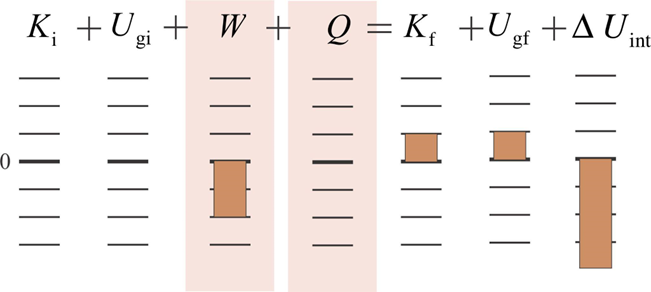
System: water and air initially in the plastic container, Earth
| Code Indications | Description | Example (Score: 2) |
|---|---|---|
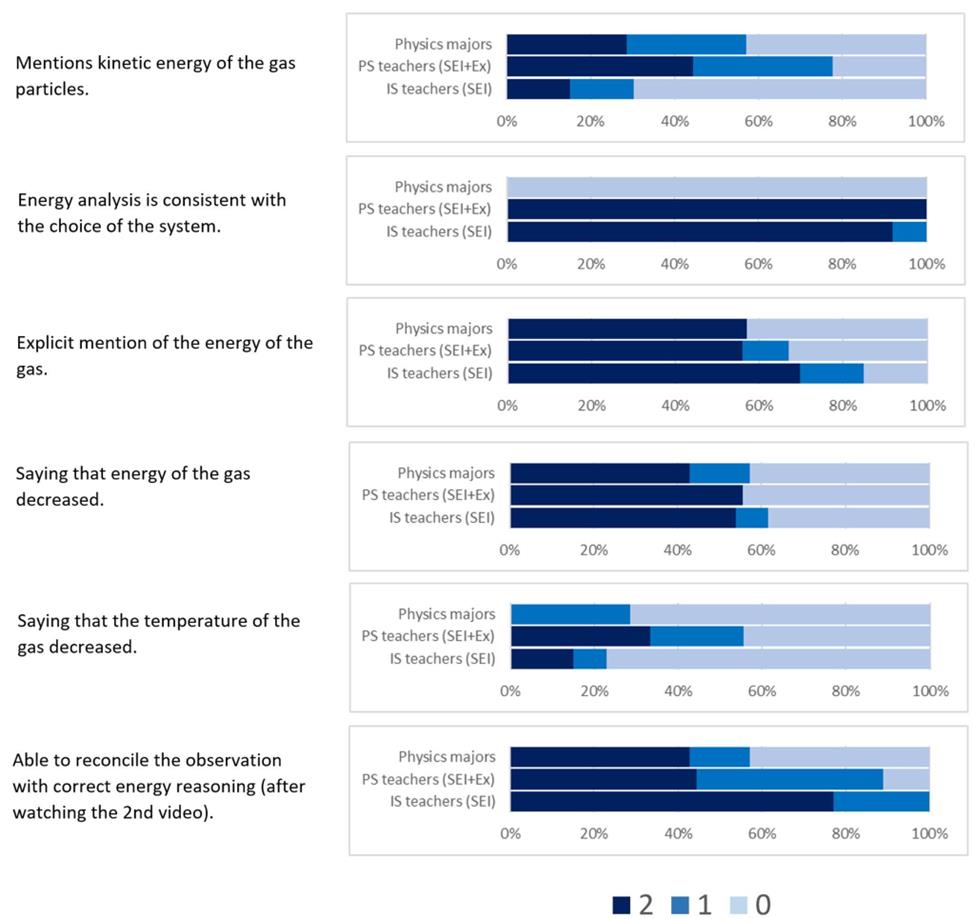
| Gas particles have kinetic energy | The participant attributes the energy of the gas inside to the kinetic energy of the particles. | The internal energy from the faster-moving air particles and the thermal energy from the increased temperature from the increased pressure are converted to kinetic energy in the water particles. |
| Energy analysis and choice of system | The participant analyzes the process correctly from the point of view of energy even if considering inside air doing work on the water (considering air outside the system). | System: Water, air inside tank, and Earth. When the valve is opened, the water shoots up, meaning it gains both KE and GPE. The energy must be coming from the expansion of the compressed air inside the tank, because as it expands, it loses internal energy and thus temperature. |
| Gas has energy | The participant explicitly mentions the energy of the inside air. | The compressed air does work on the water, exerting a force on it once the valve is opened. Positive work in this case as it increases the energy of the system. In order for the gas to do positive work, this means that if you take the gas as your system, its energy decreases. |
| Energy of gas decreased | The participant says that the energy of the inside air decreased. | See above |
| Temperature of the gas decreased | The participant says that the temperature of the inside air decreased. | When the valve is opened, the water shoots up, meaning it gains both KE and GPE. The energy must be coming from the expansion of the compressed air inside the tank, because as it expands, it loses internal energy and thus temperature. |
| Is able to reconcile the observation of temperature drop | After watching the second video, the participant revises their reasoning if needed to correct the accounting of the energy of the inside air. | The reduction in temperature would mean that there’s a change in thermal energy that is not insignificant, meaning that I would also have to incorporate that into my analysis. Basically, I treated the previous process as being isothermal, but I think the broad conclusion (an overall reduction in internal energy leads to increase in KE + GPE) is still correct. |
Question:
A person carefully lowers a bowling ball from eye level to waist level. During this motion the bowling ball moves downward at a slow, constant speed. Describe what you think is happening with energy during this process in as much detail as possible. Please include all relevant objects (bowling ball, person, Earth, surrounding air, etc. . .) in your system for energy analysis and make sure to describe where the energy goes.
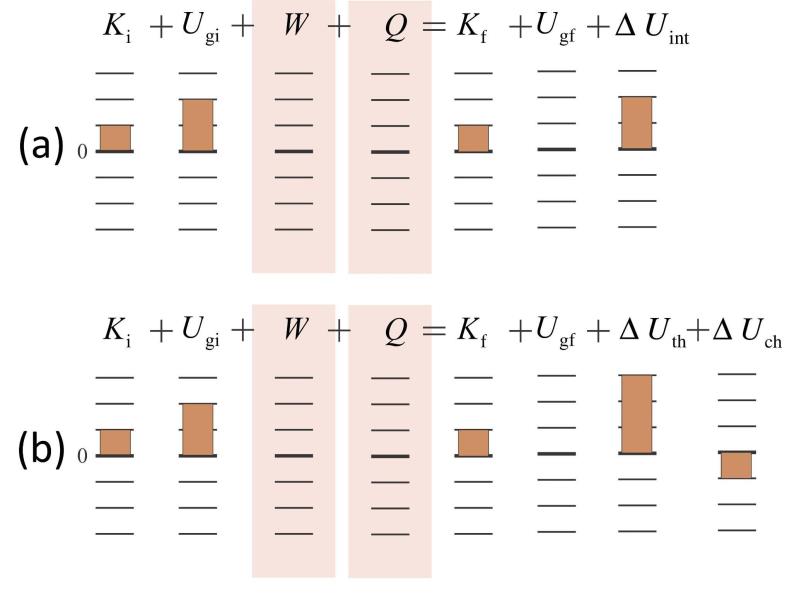
System: ball, person, Earth, outside air
| Code Indications | Description | Example (Score: 2) |
|---|---|---|
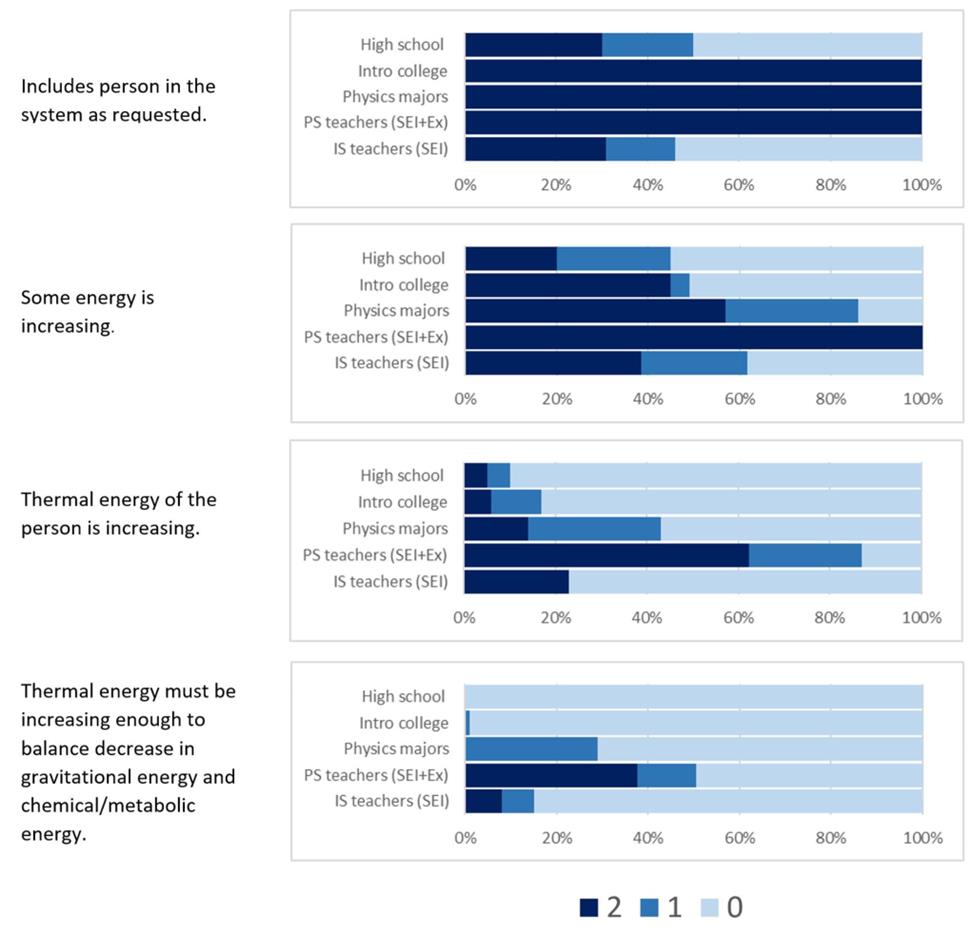
| Includes person in system | Excluding the person from the system removes internal energy change (the purpose of the research), so the problem asked to include all relevant objects in the system. Some participants declined and used the person as an external object who does negative work, resulting in 0s. Highest scores were assigned to those who explicitly included the person in the system. | System: everything. The decrease in GPE leads to an increase in internal energy of the body, surrounding air, etc. (warming up, chemical reactions within body/muscles). |
| Some energy is increasing | The participant understands that some energy is increasing in the process but does not necessarily say what this energy is. | Because there is a decrease in gravitational potential energy, the other objects in the system must have an increase in energy. |
| Thermal energy of person is increasing | The participant states the lost gravitational potential energy of the system was transferred to the person but does not necessarily articulate what energies decreased. | System: everything. The decrease in GPE leads to an increase in internal energy of the body, surrounding air, etc. (warming up, chemical reactions within body/muscles). |
| Energy balance is complete and correct. | The participant states the thermal energy of the person must be increasing enough to balance the decrease in gravitational energy and chemical/metabolic energy. | The potential energy of the system decreases because the elevation of the ball lowers. Because of muscle twitching, the person’s chemical internal energy also decreases. In turn, the person’s inner thermal energy increases, so the net energy change of the system is 0 as no work was done on the system. |
 PDF
PDF